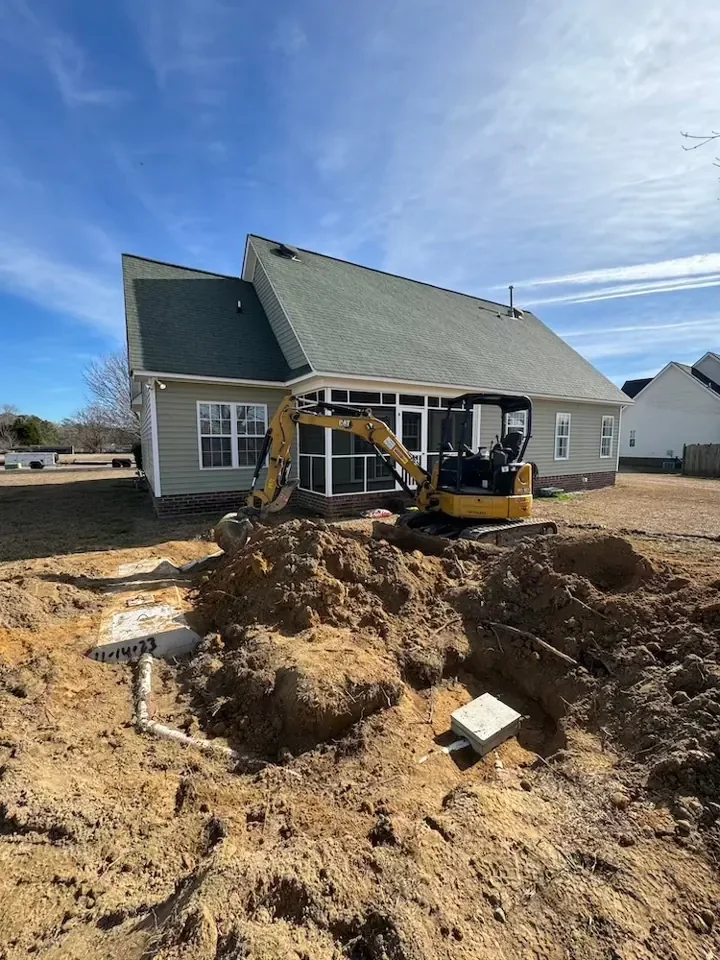
Where does septic still make sense in a growing place like Evans?
On the edges. Most of Evans sits inside the area Columbia County serves with public water and sewer, so septic tank installation in Evans is mostly for homesites at the rural fringe, on larger lots off the main corridors, and in the lake-area neighborhoods the county expects to stay on septic and wells.
Evans is an unincorporated community, not a city, so every permit for a house here comes from Columbia County. Its population climbed from 29,011 in the 2010 census to 34,536 in 2020 (Wikipedia, citing the census), and the county's Columbia County Comprehensive Plan 2021 expects Columbia County to stay the fastest growing county in the region. Growth like that fills in the sewered core first. The septic work follows the new houses outward.
That is where we come in: a tank and field sized to the house, set where the soil and the state distances allow, and left open until the county inspector has seen it.
Which parts of Evans are planned for sewer, and which for septic?
The county's character map answers it in broad strokes. Its Neighborhoods areas, which cover much of Evans, Martinez and Grovetown, get public water and sewer. Its Rural Neighborhoods get sewer only in limited areas. Its Rural Areas, on the western side of the county, sit outside the sewer service area on purpose.
| County plan area | Sewer or septic | Lot size in the plan |
|---|---|---|
| Neighborhoods (much of Evans) | Public water and sewer | 1 to 3 homes per acre |
| Rural Neighborhoods (the transition ring) | Sewer in limited areas, septic elsewhere | About 1 acre |
| Lake Neighborhood | Septic, with private wells or water systems | 1 home per acre |
| Rural Areas (western county) | Septic; sewer extensions avoided | 2.5 acres minimum |
Source: Columbia County Comprehensive Plan 2021, character area descriptions. The plan is a guide for future growth, not a parcel map, so confirm your own lot with the county.
The practical upshot for an Evans buyer: a lot on the outer edge of a newer subdivision, or a wooded tract off a county road, may never see a sewer main. Ask before you close, not after the slab is poured.
What does Columbia County ask for before an Evans house gets a building permit?
Proof of how the house will handle wastewater. The building permit checklist asks for either a receipt for paid sewer tap fees from the Water Utility or a septic tank permit from the Health Department.
The same county packet lists the order the paperwork lands in: plot plan, building application, land disturbance application, energy code check, the sewer tap receipt or septic form, and the house plans. It also says the erosion and sediment control inspection has to pass before any other inspection can be requested. On a septic lot, that means silt fence and site stabilization come first, and the septic inspection waits its turn.
The septic permit itself follows Georgia's statewide rule chapter. A certified soil classifier evaluates the site, the Health Department reviews the report and the plan, and Rule 511-3-1-.03(4) keeps the trenches open until the final inspection is done. We line those steps up so the builder is not waiting on us.
Septic permits for Evans: Columbia County
Columbia County Health Department
Phone: 706-868-3330, the number the county's own permit packets give for septic tank and well permits.
Source: Columbia County permit packet.
What do larger Evans homesites need from the septic layout?
Room for the field, kept clear of everything else the owner wants on the land: the driveway, a pool, a shop building, and sometimes a well.
Bigger lots invite bigger plans, and the drain field is the one feature that cannot be moved later without digging it up. Georgia's distances are the floor. A tank sits at least 10 feet from the property line and the foundation, and 50 feet from a well. A field sits at least 5 feet from the property line and 100 feet from a well. The setback planner lets you test a spot against those numbers before the house is staked.
- Mark the field area before clearing starts, so equipment stays off the soil the permit was based on.
- Decide on a pool or outbuilding early. Both have setbacks from the field.
- Count bedrooms honestly, including a bonus room. Tank size follows bedroom count under Rule 511-3-1-.05(3).
- If the best soil is uphill from the house, plan on a pump tank rather than squeezing the field into poor ground.
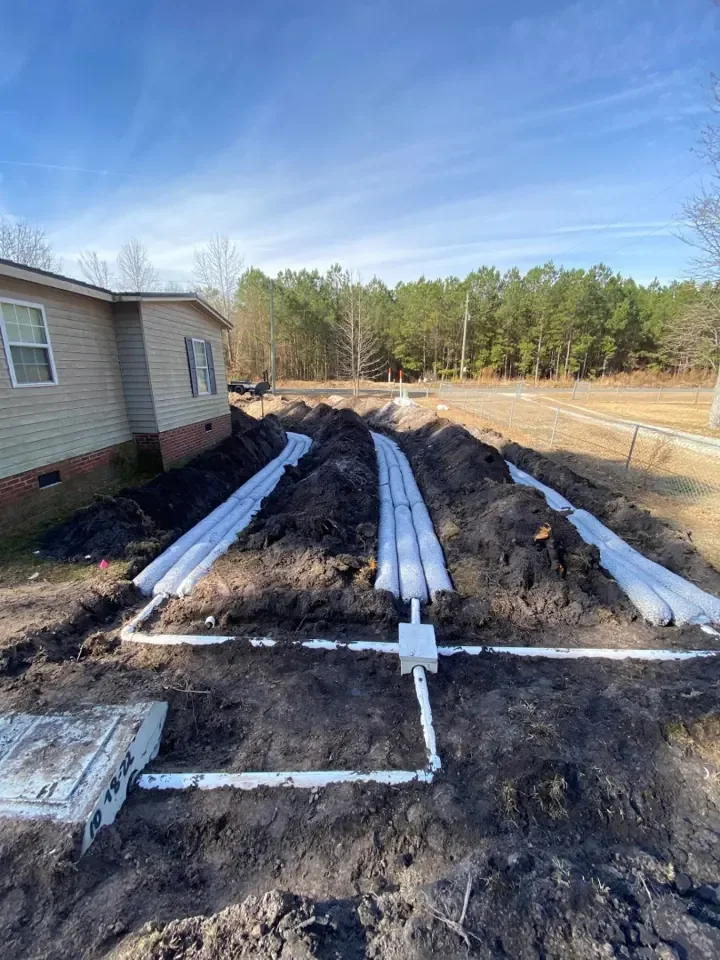
Which towns border Evans, and does the permit office change?
The office only changes if you cross into Richmond County. Evans touches Martinez and Augusta to the southeast; Grovetown, where the southern end of the Euchee Creek Greenway runs, and Appling, still the official county seat, round out the neighbors on the Georgia side.
Martinez and Grovetown share the Columbia County office with Evans, so a builder working all three uses the same Health Department and the same building checklist; Grovetown adds its own city sewer, which changes the question more than the office does. Appling, the historic county seat, is where the land opens up into acreage and septic becomes the norm. Cross into Augusta and the permit moves to the Richmond County environmental health office instead.
Around town, Evans Towne Center Park and the Euchee Creek Greenway, which starts at the Canterbury Farms subdivision, are good markers of how far the sewered core reaches. Lots well beyond them are the ones worth a sewer check.
What should you send us about an Evans lot?
The address or parcel number, the bedroom count, whether there is a well on or near the lot, and any soil report or plat you already have.
With that we can tell you whether the next call should go to the Water Utility or the Health Department, and we can walk the lot for a free itemized estimate that lists the tank, the field, any pump tank and the earthwork as separate lines. New builders should also read our new construction septic page, and anyone weighing a lot purchase should start with a perc test and soil evaluation.
Georgia-side Evans addresses only; South Carolina work is outside what we do.