Is every home in Blythe on septic?
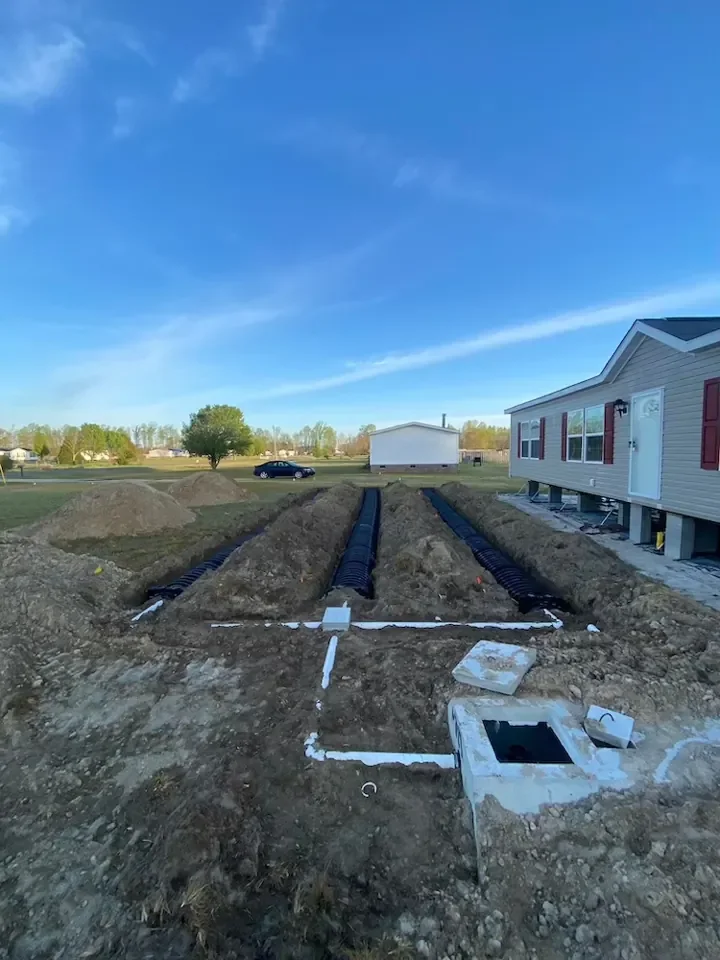
Yes. Blythe has its own water system but no public sewer, so every house in town drains to its own tank and field. Septic tank installation in Blythe, GA covers new homes, replacement systems and manufactured homes going onto family land.
The City of Blythe Comprehensive Plan 2023 to 2028 says it in one line: the city does not offer sanitary sewer services, and residents have septic tanks. Water comes from the city's own wells, stored in a 100,000 gallon tank. That combination, city water and private septic, shapes every job here, because the water service line to each house has to keep its 10 foot distance from the tank and the field.
Blythe is small, 744 people at the 2020 census, and mostly in Richmond County with a sliver in Burke County (Wikipedia). Like Hephzibah, it kept its own city government when Augusta and Richmond County consolidated.
What does a one-acre Blythe lot need from its septic layout?
A field on the best soil, kept clear of the water line, the house, the property lines and anywhere water pools. One acre is the minimum lot size in Blythe's residential districts, so space is rarely the problem; placement is.
The city's plan describes Blythe as about 60 percent rural residential and 30 percent agricultural land, with low density development the goal. Its streets are mostly rural in character, with drainage ditches along the sides and few sidewalks. On a lot like that we look at:
- Where the water service enters from the road, so trenches cross nowhere near it.
- Any old well on the lot or next door. A field needs 100 feet from a well and a tank needs 50.
- Low ground and ditch lines, which the field should avoid.
- Room for a future addition, porch or carport that would otherwise land on the field.
The setback planner checks any spot against Georgia's minimums before the soil classifier visits.
Why do so many Blythe septic jobs involve manufactured homes?
Because manufactured homes are a big share of the housing. The city's plan counts 101 mobile homes among 232 housing units, close to half.
A manufactured home needs the same permit and inspection as a site-built house, and the system is sized the same way, by bedrooms, under Rule 511-3-1-.05(3): 1,000 gallons for one to four bedrooms, with more above that. What differs is the order. The septic permit and layout should come before the home is set, so the delivery truck and the piers do not end up over the field. Our mobile home septic page covers single-wides, double-wides and swapping an old home for a new one.
What can Sand Hills soils do to a field?
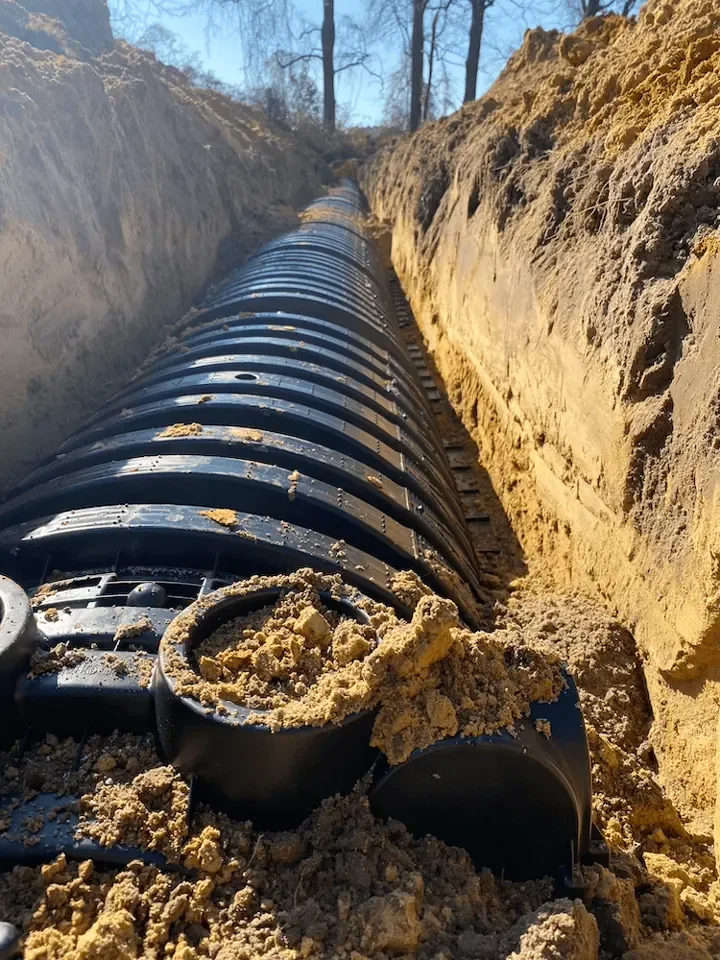
Two opposite things. Some sandy soils let water race through; others hide a dense layer that slows it down. The soil classifier tells you which one you have.
The New Georgia Encyclopedia describes Georgia's fall-line sandhills as thick sand deposits that are highly permeable and very low in water-holding capacity, often under longleaf pine and turkey oak. The USDA describes a different Sand Hills soil, the Vaucluse series, as well drained at the surface but with a subsoil that is compact, dense and brittle in places, with moderately slow to slow permeability. A drain field designed for the first would struggle in the second.
That is why the soil report comes before any estimate we write. Under Rule 511-3-1-.03(7) it has to come from a Department-certified classifier. The soil evaluation page explains what happens on the day.
How does a Blythe septic job move from call to cover?
Site visit
We find the water line, the property corners, any wells and the low ground, and talk through the house or home going in.
Soil evaluation
A certified classifier logs the soil where the field should go.
County permit
Richmond County environmental health reviews the report and issues the permit; Burke County does it for the Burke side.
Install
Tank set level, lines to the distribution box, trenches cut to the depths on the permit.
Inspect, then cover
Nothing is backfilled until the county signs off.
Septic permits for Blythe: Richmond County
East Central Health District office, Georgia Department of Public Health
1916 North Leg Road
Augusta, GA 30909
Main line: 706-667-4250. Ask for environmental health about a septic permit.
Which nearby places matter for a Blythe septic job?
Hephzibah, Augusta and Fort Gordon's Gate 5, plus the Burke County line along the edge of town.
Hephzibah shares the Richmond County permit office with Blythe and has its own sewer only around its city center, so its outer lots look a lot like Blythe's. Augusta lies about 20 miles to the northeast; US 1, Deans Bridge Road, and State Route 88 both run through Blythe. Fort Gordon's Gate 5 sits close enough that the city plan lists it as a local factor. Lots across the Burke County line use Burke's health department instead.