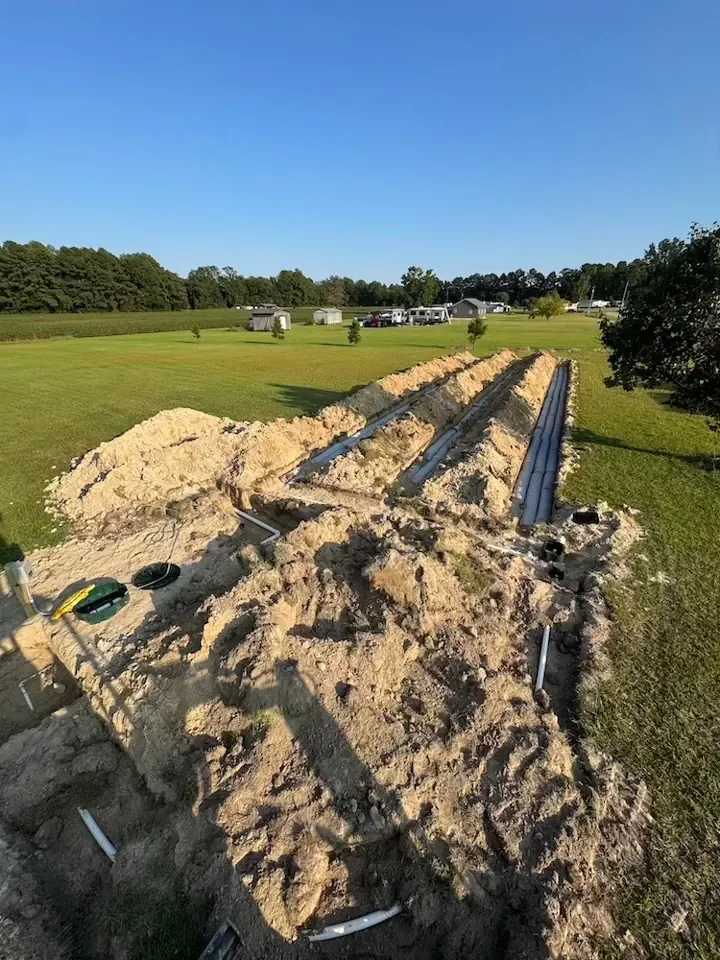
Why is septic the default around Appling?
Because the county plans it that way. Columbia County's Columbia County Comprehensive Plan 2021 keeps its Rural Areas outside the sewer service area, with a 2.5 acre minimum lot size, and lists septic systems and private wells as the infrastructure at Historic Appling. Septic tank installation in Appling, GA is the normal way to build a home here, not a workaround.
Appling is small, 658 people at the 2020 census, and no longer a city at all; it gave up its charter in 1995 (Wikipedia). It is still the official seat of Columbia County, though county government and the courts now work out of Evans. The old courthouse, remodeled in the 1850s, has been on the National Register of Historic Places since 1980.
The plan also names Appling-Harlem Road and Scotts Ferry Road, which runs from Historic Appling to Pollard's Corner, as rural corridors the county wants to keep rural as they develop. A homesite on either one should be planned around a well, a tank and a field from day one.
What does the Appling soil series say about land here?
That good septic ground exists here, and that it is not everywhere. The USDA's official description of the Appling series lists its origin as Columbia County, Georgia, in 1911, and describes a well drained soil with moderate permeability on broad, gently sloping Piedmont ridges, deep to weathered rock.
Soil like that tends to take a drain field well. The same description names neighboring soils that do not: Worsham, which is poorly drained, and Colfax, which carries a fragipan, a dense layer that slows water. On a single tract you can have a ridge of one and a low corner of the other.
- Ridges and gentle side slopes are the first places we look for a field.
- Low spots, wet-weather drains and the base of a slope are the last.
- Pasture and old cropland can hide compaction from years of equipment; the classifier's log will show it.
Georgia requires that log to come from a Department-certified soil classifier under Rule 511-3-1-.03(7). Our perc test and soil evaluation page explains what happens on the day.
How do you fit a well and a septic system on the same acreage?
Place the field first on the best soil, then put the well uphill and at least 100 feet away. A tank needs 50 feet from the well.
| Distance from | Septic tank | Drain field |
|---|---|---|
| Any well, yours or a neighbor's | 50 ft | 100 ft |
| Creek, pond or lake (normal water level) | 25 ft | 50 ft |
| Property line | 10 ft | 5 ft |
From Georgia DPH Rules 511-3-1-.05(2) and .07(3). The county can ask for more on a given site.
The common trap on country land is drilling the well first, wherever the driller's truck could reach, and then discovering the only good field soil is 60 feet downhill from it. Decide both together. The setback planner draws the rings so you can try layouts at the kitchen table.
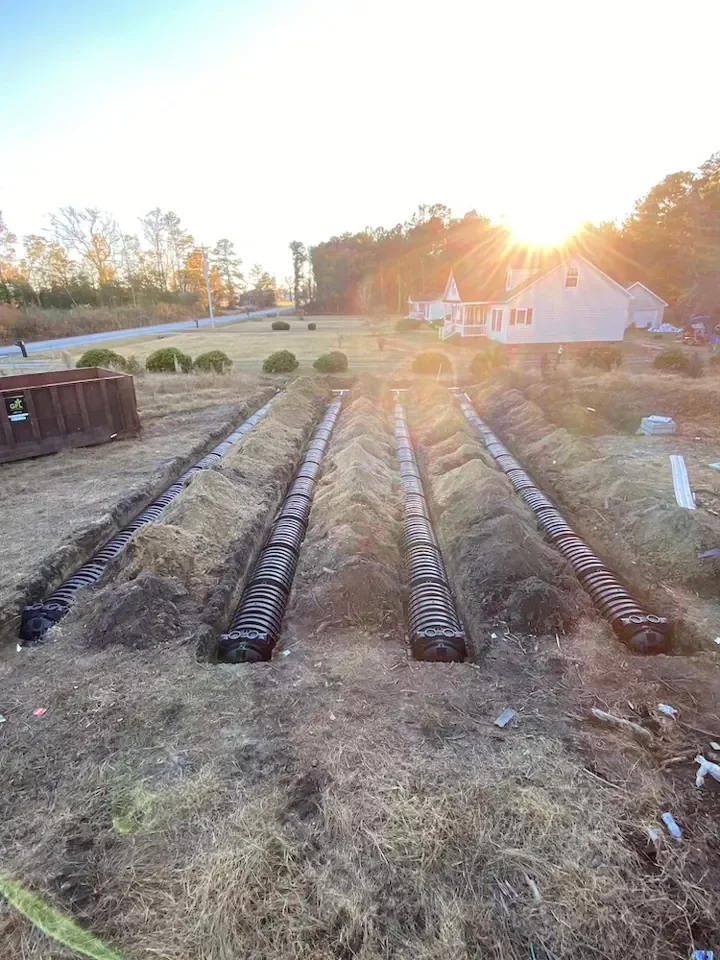
What changes near Kiokee Creek or Clarks Hill Lake?
More distance and more paperwork. Great Kiokee Creek runs through Appling, and any lot near it or another stream, pond or the lake has to keep the tank 25 feet and the field 50 feet back from normal water level.
Columbia County's residential permit packet adds that building sites within 200 linear feet of a state water need an approved, stand-alone erosion control plan before a building permit is issued, and the erosion inspection has to pass before any other inspection is scheduled. Closer to the lake, the county plan defers to the Army Corps of Engineers' shoreline management plan for J. Strom Thurmond Lake, and its lake-area neighborhoods are expected to use septic and private wells too.
Ask the county before you clear near a creek. Fixing a missed erosion control plan costs more than writing one.
What if the house sits a long way from the good soil?
Run a longer line or add a pump. Long building sewers work when there is steady fall from the house to the tank; a pump tank handles the rest.
On acreage the tank usually sits close to the house, and it is the line from the tank to the field that gets long. A pump tank with floats and a high-water alarm can push effluent uphill or across a long flat stretch to the field area the soil report picked. The free itemized estimate lists the pump, the alarm and the extra line on their own rows, so you can see what the distance costs.
Septic permits for Appling: Columbia County
Columbia County Health Department
Phone: 706-868-3330, the number the county's own permit packets give for septic tank and well permits.
Source: Columbia County permit packet.
Which towns are Appling’s neighbors for septic work?
Harlem down US 221, Evans toward the river, and the lake country to the north, all permitted through the same Columbia County office.
Harlem sits at the other end of Appling-Harlem Road, with its own town sewer inside the older streets and septic on the rural lots around it. Evans, where county government actually works today, is mostly sewered, so septic jobs there lean toward the edges. Up toward Pollard's Corner and the lake, the pattern looks like Appling: wells, acreage and fields. The Amazon distribution center the county plan places in Appling is a reminder that growth is reaching this part of the county too.